How many grafts are needed? Norwood ladder guide with estimates and prices
"How many grafts do I need?" it is the question that determines everything: technique, duration of the intervention and price. The answer depends on a classification that doctors have been using for decades: the Norwood scale, which measures the stage of male thinning from 1 to 7.
In this guide we translate it into practical numbers: for each stage, how many grafts are needed on average, what you can expect and how much it costs. With an honest warning: the final estimate is made only on your photos, because the donor area is different for everyone.
First: what is a graft
A graft (or follicular unit) is the "building block" of the transplant: a small group of 1–4 bulbs that grow together naturally. On average each graft contains approximately 2.2 hairs: 2,500 grafts therefore approximately 5,500 hairs move from the nape of the neck to the thinning areas.
Beware of those who purposely confuse: "4,000 hairs" are not "4,000 grafts". In serious estimates we always talk about grafts — and the number must be written in black and white.
The Norwood scale, stage by stage
| Norwood Stadium | Situation | Indicative grafts | Package price |
|---|---|---|---|
| Norwood 2 | Initial receding hairline, receding line | 1.200 – 1.800 | from €1,490 (FUE) |
| Norwood 3 | Deep receding hairline or pale hairline | 1.800 – 2.500 | from €1,490 – €1,790 |
| Norwood 4 | Receding hairline + cleric separated by a bridge | 2.500 – 3.200 | from €1,790 – €2,290 |
| Norwood 5 | The bridge becomes thinner, areas almost united | 3.000 – 3.800 | from €2,290 (megasession) |
| Norwood 6 | Single hairless area front-vertex | 3.500 – 4.000+ | from €2,290, dedicated valuation |
Two important clarifications. First: from Norwood 4 onwards, strategy matters more than number — the density map distributes the bulbs where they give the greatest visual effect (first the face frame, then the rest). Second: beyond the Norwood 5-6, honesty requires checking whether a single session is enough, or whether it is necessary to plan a second one 12 months later.
What stage are you? Find out for free
Send 3 photos of the skin (forehead, top, nape) on WhatsApp: the team estimates your stage and the grafts needed in 24 hours.
The factor that decides everything: the donor area
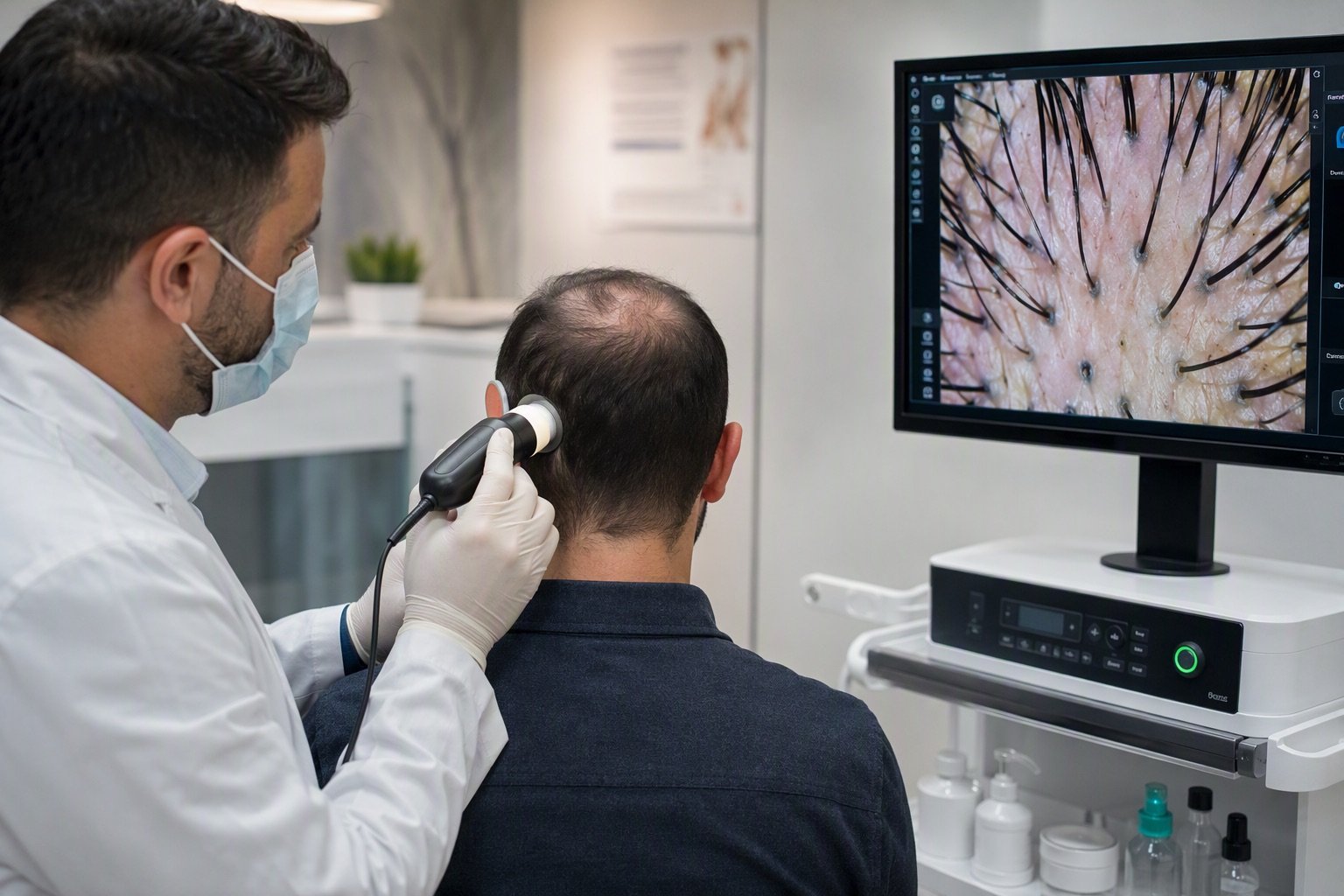
You can be Norwood 4 and have a very thick nape, or Norwood 3 with a weak donor: the feasibility changes. This is why trichoscopy and photographic evaluation are important the donor first, then thinning.
- Donor density: how many grafts can be extracted without visibly thinning it.
- Hair thickness: thick hair covers more with the same number of grafts.
- Elasticity and health of the skin: Affect extraction and healing.
- Future reserve: A serious plan always preserves bulbs for years to come, because native thinning can continue.
Remember: the transplant redistributes the hair you have, it does not create new hair. Anyone who promises you "twenty-year-old" density with a modest donor isn't doing surgery: he's doing marketing.
What about native hair? The role of PRP
Transplanted bulbs are resistant to falling, but surrounding native ones can continue to miniaturize. This is why all our packages include a post-operative PRP session and, where indicated, we recommend a maintenance cycle: protecting existing hair is part of the 5-10 year result.
The complete plan - transplant, PRP, any maintenance therapy agreed with your doctor - is written in the estimate: you know immediately what is needed today and what could be needed tomorrow.
Your estimate in 24 hours
3 photos of the skin on WhatsApp are enough for a serious estimate: Norwood stage, necessary grafts, recommended technique and closed price. Free and without obligation.
Written by
Tirana Hair Transplant Team
The Italian team that accompanies patients from the evaluation of the photos to the 12-month follow-up, in collaboration with the team of the specialized partner clinic in Tirana.